Started with big, returned to a smaller one: does provider size impacts IT services quality?

Choosing a service provider is often a headache for companies. Various criteria are evaluated - from price to service quality, from competencies to response speed. However, the size of the company often plays a role in the final decision. Smaller providers tend to offer flexibility, speed, and personal attention. Larger ones bring vast resources, mature processes, and reliability. So, which one should you choose?
Although the logic of business often suggests that “large companies should work with large providers,” in practice, more and more businesses are rethinking their choices. Some are tired of being just one of a thousand clients in a big supplier’s portfolio. Others have been burned when large providers failed to quickly adapt or solve critical situations due to a lack of flexibility.
So, does company size actually determine service quality? Is supplier size even a relevant factor when choosing a partner? When does it really matter - and when doesn’t it? What are the pros and cons of large versus smaller suppliers, and when should you choose one over the other? These are the questions we discussed in our insights for the tech news portal technews.lt.
Why Size-Based Decisions Don’t Always Work?
Marijus Strončikas, CEO of IT services company Altic IT, explains that a common mistake when choosing IT or other service providers is basing the decision on brand recognition, image, or size - assuming that “big means reliable.” This creates an illusion of safety, while the essential question gets overlooked: does the supplier actually meet your specific needs?
“Regardless of the supplier’s size, a certain number of specialists and dedicated teams are assigned to the services relevant to the client - not the entire company, not hundreds or thousands of employees. So clearly, at this level, size becomes irrelevant. What matters is the experience and competence of specific specialists, the efficiency of internal processes, modernity of tools used, automation, and the ability to share knowledge and analyze data,” says Mr. Strončikas.
Still, he notes, the number of experienced specialists in a company can be an important indicator.
“An external IT provider must ensure service quality regardless of whether a particular specialist is on vacation, on sick leave, or even leaves the company - someone else must step in until a replacement is found. That’s why it’s crucial that a small supplier is not ‘too small’ and has at least 2-3 specialists for each key area of competence,” he adds.
Apples to Apples: Make Fair Comparisons
However, Mr. Strončikas emphasizes that the number of specialists alone can’t be the main selection criterion - you need to compare apples to apples. And to do that, you must first clearly define your needs and selection criteria: what services are needed, how many, in what locations, desired response times and service level parameters (SLA, RTO, RPO), service delivery processes, and tools used.
“Many clients describe their needs superficially or explain them verbally. That makes proposal comparison difficult and subjective. Marketing tricks often skew the picture, form overtakes substance, and attention shifts away from key criteria. That’s why it’s critical to define your requirements precisely - this helps assess provider competencies, tools used, value delivered, and the real business problems solved,” says Mr. Strončikas.
He also notes that it’s important to understand what kind of IT specialization a client actually needs. The IT services field is broad and segmented: some companies develop and code solutions, others provide infrastructure and hosting, and some focus on IT support and operations.
“Large IT companies usually operate across many IT areas. So when comparing a large provider to a smaller one, it's important to compare their respective departments - for instance, compare the larger provider’s IT support division with a smaller, specialized IT operations company,” he adds.
Go Big: When Standardized Services Are a Priority
There are cases where larger providers have a real edge - especially when clear, standardized processes and services are needed. Their scale often means greater efficiency and cost competitiveness. Larger companies also typically present lower continuity risk.
But drawbacks exist too: inflexibility, long and rigid contracts, one-size-fits-all solutions that don’t meet the specific needs of demanding clients.
“Some clients get tired of dealing with large providers that can’t or won’t adapt their processes. And even when they do, it takes forever. For example, if a client wants a new service, the big provider usually needs to rewrite the contract. Aligning all legal terms can take months. A smaller provider is typically much more flexible - even in undocumented scenarios, they tend to act in the client’s best interest,” says Mr. Strončikas.
He adds that big providers often push for fixed-term contracts with penalties or compensation clauses if the client terminates early - such as repaying discounts or paying out the remaining contract term. If quality issues arise, big suppliers often have the legal muscle to reduce liability or avoid compensation.
Go Small: When You Need Flexibility and Speed
Mr. Strončikas points out that smaller providers often have the advantages big ones lack - flexibility, adaptability, and the ability to align with client processes instead of forcing clients to align with theirs.
“They’re quicker to approve service changes, more responsive to client needs, and more motivated to deliver quality - because they know an unhappy client can easily switch. For example, we at Altic IT always offer new clients the option to ‘try us out’ - we don’t lock them into long-term contracts. If the trial goes well, we expand the service scope. More and more, clients are switching from big to small for faster response, personalized service, and flexibility,” he shares.
One such example is MV GROUP - one of the largest business groups in the Baltics. Seeking a partner who could ensure 24/7 system stability, quick response, and high competence, they chose Altic IT - a smaller provider than their previous one.
“Given the volume of services and criticality of their systems, we even developed a unique, custom service model for them. The result? Faster incident response, quicker implementation, automated tools, and more client-focused processes,” says Mr. Strončikas.
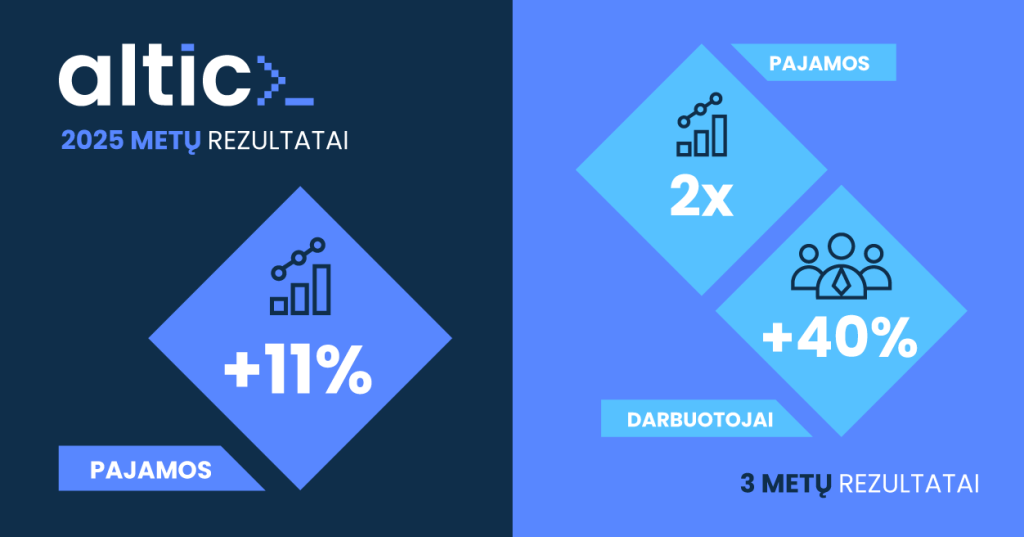
He adds that when choosing a smaller provider, it’s essential to evaluate their growth trajectory. Some small companies remain small because they fail to automate or scale - that’s a risk signal. But a company that’s growing consistently and outperforming the market indicates a competitive advantage.
Start With the Outcome You Want
In conclusion, Mr. Strončikas says supplier size only matters if it aligns with a company’s specific needs. Once those are defined, the focus should be on results: what challenges will be solved, what outcomes delivered - not just on service details and price. In most cases, the difference in pricing between providers is far smaller than the business value of faster, more stable IT.
“A good provider knows what results they can deliver and how to measure quality. So once the client’s needs are clarified, both parties should agree on the desired outcomes, performance metrics, and the supplier’s accountability for service quality,” he concludes.